
Built to stay ahead in the AI era
Upgrade your fraud and identity decisioning with next-generation AI. Detect emerging fraud earlier, reduce false positives, and continuously improve performance—without rebuilding your stack.
The next frontier in fraud prevention
Sigma V5 is powered by proprietary, fraud-focused transformer architectures that were purpose-built for fraud prevention. Replacing the industry’s standard tree-based models, this patent-pending model evaluates every signal in context, learning from billions of identity records and surfacing fraud patterns that previous architectures were fundamentally incapable of seeing.
The numbers don’t lie
Sigma V5 is the most accurate model yet, empowering you to prevent fraud attempts while maximizing growth.
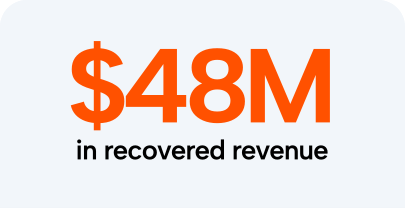
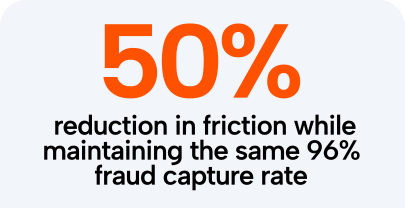
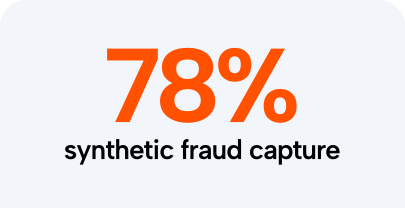
This early performance data highlights the greater outcomes that can be achieved with V5. Here’s what drives them.
Tree-based models hit a wall
Traditional, tree-based models (like XGBoost and GBM) have been the industry standard for years, and for good reason. They work when fraud patterns are stable, data is abundant, and attackers play by known rules.
But none of those conditions hold true anymore.
These older models evaluate signals one step at a time through fixed decision paths. They can’t adapt when fraud is dynamic. They struggle in low-signal environments, and skilled fraudsters have learned to deliberately exploit their assumptions and inject just enough noise to slip through the cracks without triggering thresholds.
The result is a growing detection gap that no amount of feature engineering can close. The architecture itself has a ceiling.
Tree-Based Models (XGBoost / GBM) |
Sigma V5: Transformer Architectures |

Sequential feature evaluation, one signal at a time |

All signals evaluated simultaneously via self-attention |
|
Rigid decision boundaries that are gameable by adversaries |
Continuous identity representations that are context-aware |
|
No learning from unlabeled data |
Pre-training on labeled and unlabeled data |
|
Brittle on thin files or sparse data |
Robust in low-signal environments via learned representations |
|
Each model trained from scratch |
Transfer learning enables rapid adaptation |
|
Manual feature engineering required |
Automatic feature discovery via embedding space |
The Socure advantage
Transformer architectures are powerful. What makes Sigma V5 uniquely Socure is what feeds it.
Fraud rings don’t hide from the graph
At the core of V5 is Socure’s Identity Graph, one of the most comprehensive in the industry.
The graph doesn’t just provide features; it exposes the organized relational webs that are inherent to fraud and invisible in legitimate behavior. Coordinated fraud rings, shared device clusters, application velocity patterns; these signals don’t appear in individual records. They emerge from the graph. V5 is built to exploit that, allowing you to more confidently separate legitimate users from fraudsters and apply friction only where it’s needed.
The synthetic identity tell
Fraudsters randomize synthetic identities, but they can’t randomize everything. Even when SSNs appear unique, there are hidden statistical patterns such as tendencies to reuse or cycle through specific prefixes that expose fabricated identities under scrutiny. V5’s new synthetic anomaly detectors go beyond the traditional three-identifier check of name, DOB, and SSN to surface exactly these kinds of tells, catching the most carefully constructed synthetic identities that previous models missed.
Real-time breach intelligence
When a data breach occurs, risk doesn’t spread evenly; it concentrates. V5 doesn’t just flag whether an identity appeared in a breach; it measures how heavily that breach is driving application traffic in real time. This lets Socure quantify who is most vulnerable in the moment and apply friction selectively, rather than casting a wide net that degrades experience for legitimate users.
New labeling methodologies
Garbage in, garbage out. V5 attacks the problem at the source. By combining transformer embeddings, which surface hidden patterns strongly correlated with fraud, with credit header fraud alerts that document what actually happened to real victims, Socure has built a new labeling methodology that produces higher-quality training data. Better data means more precise detection, not just more powerful architecture.
Architecture that is built to learn, and built to last
V5 isn’t just a new model. It’s the foundation of a new engine.

Autonomous model improvement
Agents continuously curate training datasets, discover new features, and retrain and validate models so performance is persistent, and never degrades between release cycles.

Continuous feedback loop
Attacks are identified, context is surfaced, defenses are updated. Not quarterly. Continuously. The system improves in real time, every time fraud evolves.

Always-on innovation
Upgrading shouldn’t require a months-long engineering project. V5 is architected for seamless migration and rapid adoption, so your team spends time acting on better intelligence, rather than just integrating it.

Unified ecosystem
V5 is the first expression of Socure’s connected architecture, where every signal, every system, and every customer’s data contributes to a shared, always-improving defense.
A unified, holistic fraud solution
Sigma V5 doesn’t operate in isolation. It’s the intelligence layer at the center of RiskOS®, Socure’s unified operating environment for fraud and identity risk.
Let us prove it.
See how Sigma V5 can help you detect fraud earlier, improve approvals, and continuously strengthen your risk decisions. Speak with a Socure expert to learn more.