
Socure’s Age Assurance Approach & Supporting OpenAge
Proving whether a user meets an age requirement is becoming a legal requirement for digital platforms worldwide. New laws in the U.S., U.K., European Union, Australia, and Brazil require companies to confirm age without forcing users to upload documents, repeat checks, or share more personal data than necessary. At the same time, users want a simple way to prove their age without repeatedly sharing IDs, selfies, or full dates of birth.
Socure’s approach to age assurance is built on proportionality, accuracy, and privacy. Not every interaction requires a document or a selfie, and forcing high friction checks too early increases both data exposure and user drop off. That is why Socure treats age assurance as a layered system rather than a single gate.
We begin with passive signals such as device intelligence, phone possession, and identity graph resolution to confirm age eligibility with minimal user input. These checks rely on real-world identity linkages and authoritative data, allowing platforms to make confident decisions without collecting unnecessary information. Active methods like selfie based age estimation and document verification are used only when higher assurance is required by regulation or risk.
Supporting the OpenAge initiative, alongside Meta and SpruceID, extends this approach by making verified age reusable.
Socure’s Multi-Layer Approach to Age Assurance
Age assurance is not a single check. It combines multiple signals so platforms can choose how much certainty they need for a given use case.
Socure supports checks that happen without asking the user to do anything, as well as active verification when stronger proof is required.
Each method is designed to keep friction low and protect user privacy.
Passive Age Checks That Require Almost No User Input
Device-based age checks using previously verified identities
Socure derives a device-level identifier based on signals from the user’s device, without relying on cookies or direct identifiers. This identifier is then mapped to the Socure Identity Graph, a network of verified identity information. If that device is already associated with an identity in the graph, Socure can determine whether the user meets an age requirement and return a simple yes or no result.
Phone number-based pre-fill with SNA or OTP
When a platform requests a phone number, Socure can verify device possession through silent network authentication or a one-time passcode. Once confirmed, the phone number is matched within the Socure Identity Graph to retrieve the verified age linked to that identity. This creates a fast and private way to confirm age using information users already have.
PII-based checks for international coverage
In many countries, age can be verified against trusted government or telecom data sources. Socure can verify age using a limited set of information, such as name and date of birth, when required by local data sources. This gives international platforms a consistent and accurate passive check without forcing users to upload documents or selfies unless it is absolutely required.
These passive approaches create a strong baseline for age assurance and keep user interaction to a minimum.
Active Age Verification When Stronger Assurance is Needed
Some situations require added confidence, such as regulatory frameworks or platform risk profiles where verified evidence may be needed rather than predictive signals. Socure supports several active methods for this.
Selfie-based age estimation
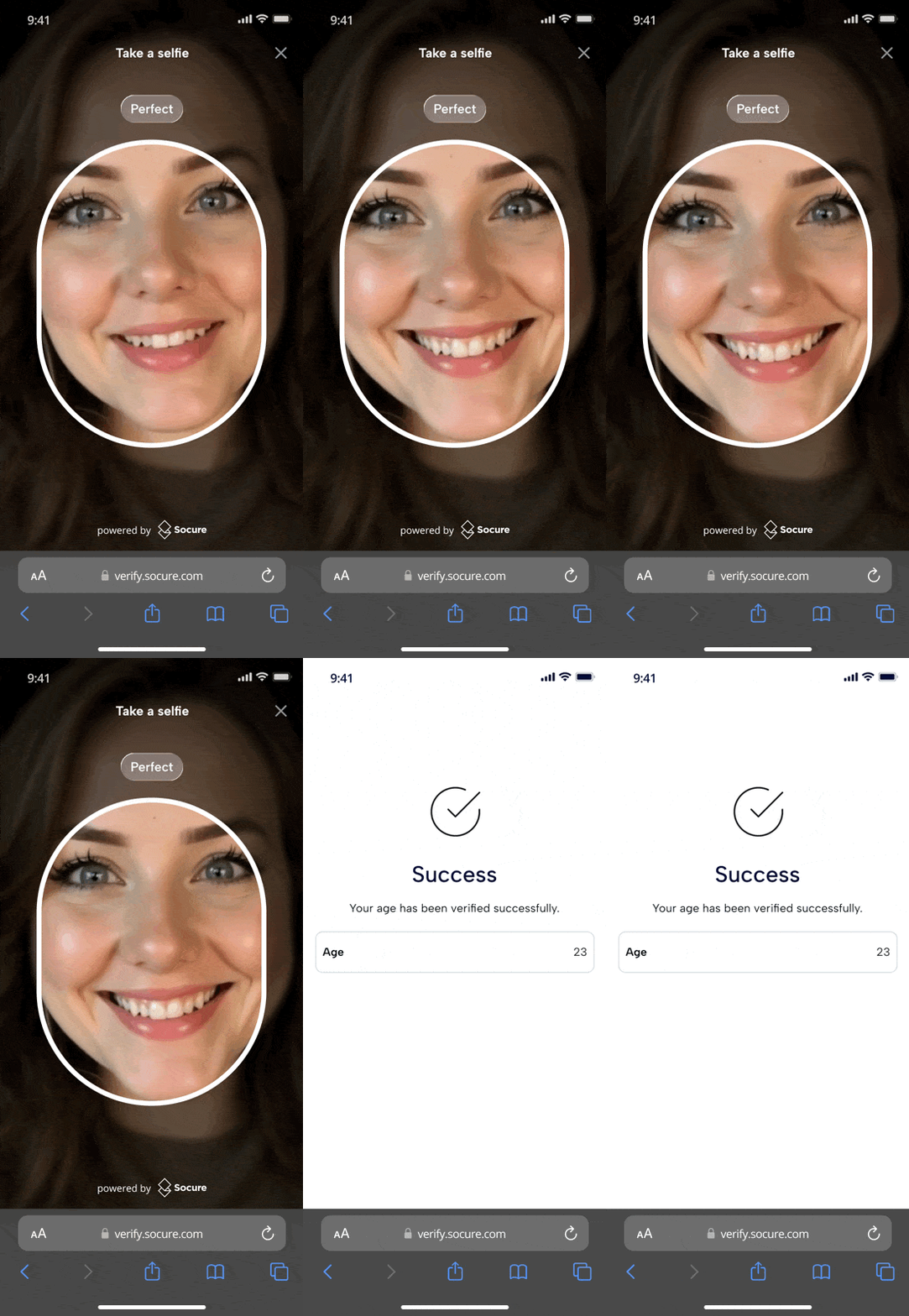
Socure’s age estimation model predicts a user’s age with a mean absolute error of 1.37 years, allowing platforms to apply age thresholds with defined buffers. The user takes a quick selfie, and the model returns an estimated age range that allows the platform to apply its threshold. This is fast, accessible, and highly accurate for many requirements.
Barcode-only age verification
Some platforms prefer a lighter workflow based only on scanning the barcode on the back of a document. Socure supports barcode-based flows for fast and reliable age confirmation.
Document-plus-selfie verification
For high assurance age checks, Socure verifies a government issued document and matches it to a selfie. The system detects tampering, image manipulation, deepfakes, and presentation attacks. This method satisfies the strictest regulatory expectations and produces verified information that can be reused.
These active methods allow platforms to escalate friction only when needed.
A Privacy-Centered & Flexible System
The goal across all of these layers is straightforward. Platforms should be able to confirm whether a user is above or below an age requirement without collecting unnecessary information. Users should not have to repeatedly share documents or selfies every time they open a new app.
Socure’s age assurance stack gives platforms a way to start with the lowest friction method — moving up only when required. This aligns with global privacy expectations and creates a consistent path for compliance.
How OpenAge & AgeKey Fits Into Socure’s Strategy
Once a user completes a higher assurance check, they should not have to repeat that process across every service. This is where AgeKey, part of the OpenAge initiative, is valuable. AgeKey allows users to verify their age once, save a private and anonymous credential, and present a simple yes-or-no eligibility signal to any participating service. This protects privacy, as the credential does not reveal personal data, track the user, or expose the underlying verification method.
Socure supports OpenAge because reusable credentials fit naturally into our age assurance strategy. Socure provides the verification event, and AgeKey allows the user to reuse the outcome. Together, they reduce friction for users, simplify compliance for platforms, and support a privacy centered model for the internet.
AgeKey does not replace Socure’s age assurance stack — it extends it, taking a verified result and making it portable across the digital ecosystem.
The Path Forward
Age assurance is becoming a core part of digital trust. Platforms need accurate and flexible solutions that scale globally, users want privacy and control, and regulators are asking for consistent protections that work across regions.
Socure is building the most complete age assurance platform to meet these needs. With device intelligence, passive checks, phone based signals, selfie estimation, document verification, barcode based workflows, parental consent support, and now integration with reusable credentials through OpenAge, Socure is driving the next chapter of safe and privacy aligned digital experiences.

Related Posts