
We Supercharged Our Pre-Sales Team Around Agents. Here's the Whole Map.
Every platform company’s revenue team runs into the same problems:
- Understanding the full nuance of the customer’s problem. Not just surface pain, but the operational, technical, compliance, and implementation realities behind it.
- Capturing that nuance in enough detail that the broader team can actually use it.
- Turning that context into the right solution while still moving the deal forward.
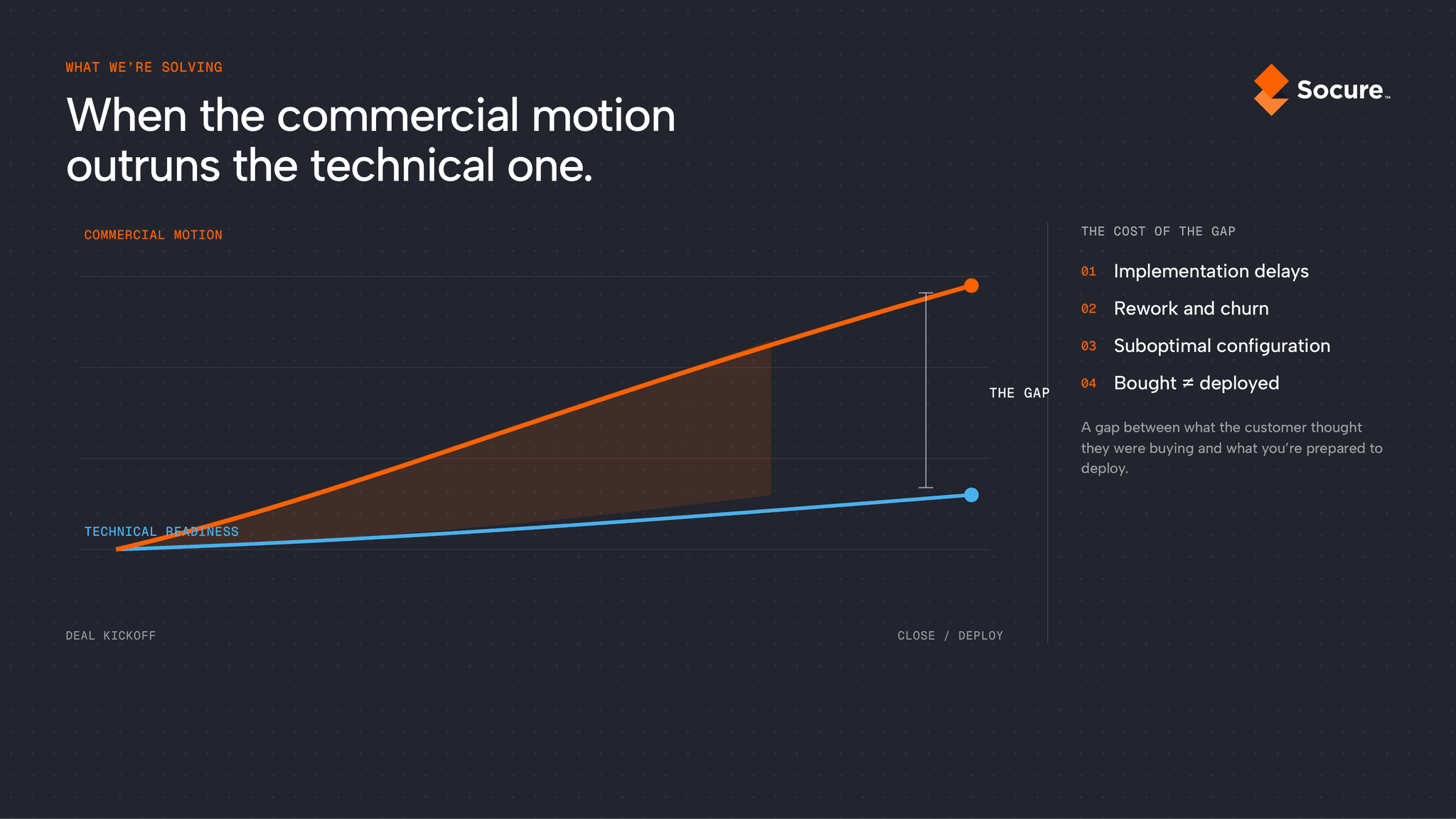
- Keeping the commercial motion from outrunning the technical one.
The cost of getting this wrong shows up later in implementation delays, rework, suboptimal configuration, and a gap between what the customer thought they were buying and what you’re prepared to deploy.
When Socure began its platform journey, we ran into all of the above. For more than a decade, we’d been solving one of the hardest intelligence problems in identity. We built one of the deepest, globally connected, and most diverse identity graphs in the ecosystem, with products designed to be easy to consume and effective at solving a specific fraud, risk, or verification problem through the lens of Identity.
But becoming a platform company required a different motion. The question was no longer “how do we make this product easy to integrate,” but “how do we make it easy for a customer to solve multiple problems, use multiple products, and solve faster without restarting the solutioning and integration process every time.”
We answered that, first, with discipline: a manual artifact called the Solution Readiness Document. Then we did something more durable. We rebuilt the team’s entire operating model around agents.
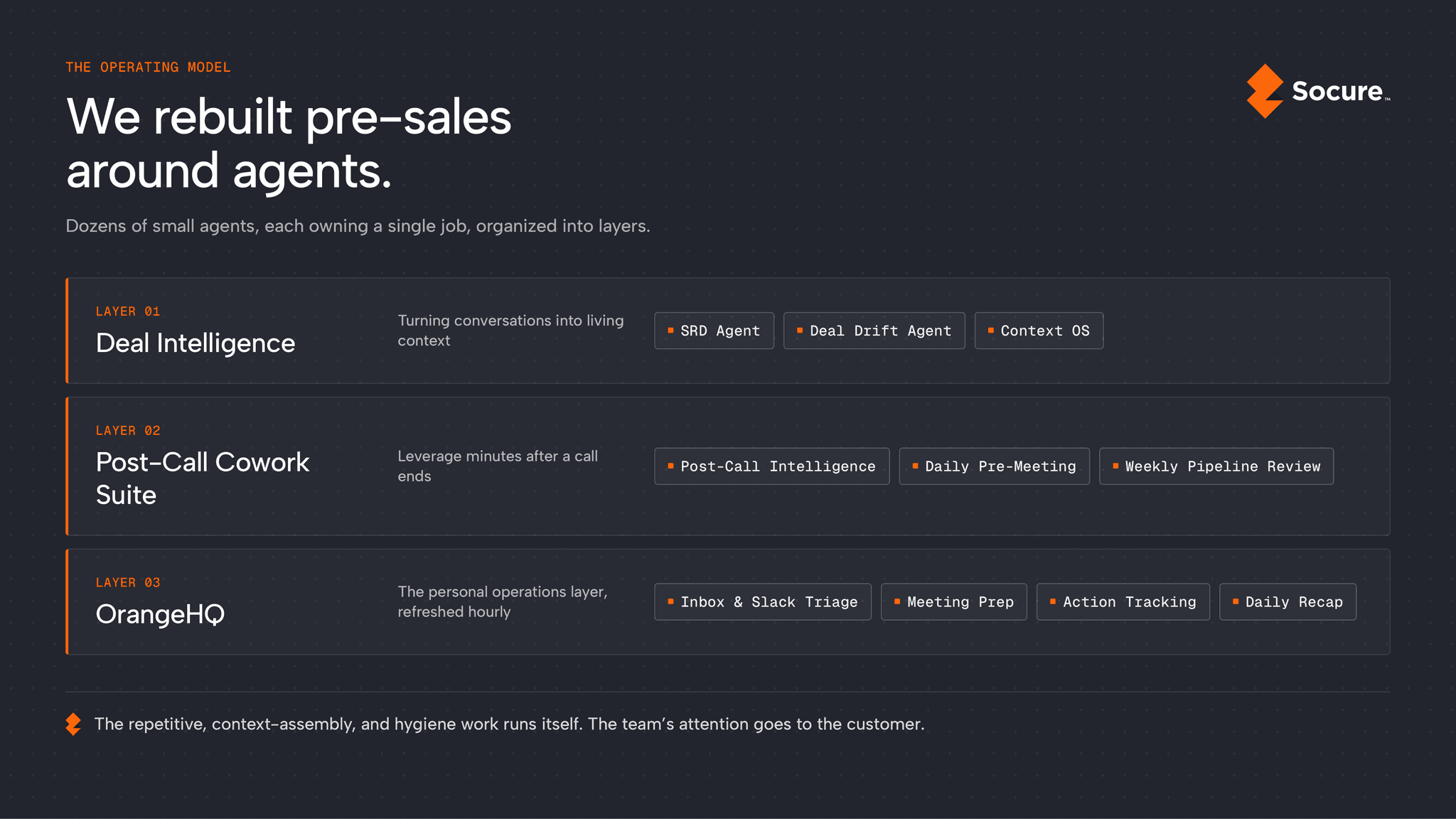
And not one agent. Dozens of small ones, each owning a single job, organized into three layers. Over this series we’ll go deep on each.
- Layer 1, Deal Intelligence. The SRD Agent, the Deal Drift Agent, and Context OS, turning scattered conversations into a living record that moves with the deal.
- Layer 2, The Post-Call Cowork Suite. Agents that turn a finished call into a manager-grade brief and assigned action items within minutes, brief the team before every meeting, and flag deals drifting off course.
- Layer 3, OrangeHQ. A personal operations dashboard that triages each SC’s email and Slack, preps their meetings, and clears the daily noise, refreshed hourly.
We didn’t bolt a tool onto the side of the workflow. We rebuilt the workflow so the repetitive, context-assembly, and hygiene work runs itself, and the team’s attention goes to the customer.
The principle: leverage and scalability
Every decision below traces back to one constraint. We were carrying a deal-to-solutions consultant ratio that no amount of heroics could sustain, and the answer wasn’t going to be “hire our way out” alone. The answer was to make each SC dramatically more effective by handing the repetitive, context-assembly, and hygiene work to agents, and reserving human judgment for the work only humans can do: understanding the customer, designing the solution, and earning trust.
We organized that work into three layers. Each layer is a set of agents. Together they cover the full arc of a deal, the full arc of a workday.
Layer 1. Deal Intelligence: Turning Conversations Into Living Context
The foundational problem is context capture. We started with the Solution Readiness Document as a deliberate bet: build 50, 60, 70 of them by hand until patterns emerged that we could automate. Like labeling tasks in machine learning, they did and that manual motion became the training data for Agent One.
Three agents now carry it.
- The SRD Agent drafts and continuously matures the solution record, scoring its own completeness and coaching the team on what’s still missing.
- The Deal Drift Agent catches the failure mode itself, when the commercial motion outruns the technical one, and names exactly where the gap is.
- Context OS, a headless deal-context repository keyed to every piece of information on every opportunity, allowing post-sales to interact with a deal-specific knowledge base and facilitate a clean handoff.
Layer 2. The Post-Call Cowork Suite: Leverage Minutes After a Call Ends
The second layer turns live deal activity into action with no manual SC effort. The moment a customer call wraps, an Orchestrator Agent detects it, figures out which deal it belongs to, and fans the work out to a set of specialists that report back as a single threaded brief in Slack, manager-grade and waiting before the rep has left their desk.
- Orchestrator Agent detects the call ending, figures out which deal it belongs to, and fans the work out to a set of specialists that report back as a single threaded brief in Slack, manager-grade and waiting before the rep has left their desk.
- The Framemaking Sales Critique Agent, inspired by Matt Thompson and Brent Adamson’s SKO 2026 session on Framemaking, assesses how well the SC controlled the frame, anchored on business pain, and shaped the customer’s evaluation criteria, then returns two things done well, two to fix, and the single highest-leverage coaching note.
- The Next-Call Planner agent reads the same transcript and hands back an attack plan for the next conversation: the one objective that matters, the agenda to get there, the questions that must be answered, and the risks that could stall go-live.
- The Action-Item Tracker agent pulls every commitment out of the call, sorts it by owner, and turns the rep’s own to-dos into assigned, deduplicated Jira tickets while keeping everyone else’s in plain view, so minutes after hang-up, the SC has a brief, a critique, a plan, and their tasks already filed without touching a keyboard.
Layer 3. OrangeHQ: The Personal Operations Layer
Deal intelligence makes the team better at deals, but an SC’s day is also email, Slack, calendars, and the constant low-grade tax of staying on top of it all. OrangeHQ is one Notion page per person, refreshed hourly by a set of cooperating agents, so the SC opens a single page and is already oriented.
- Orchestrator Agent wakes up every hour and runs the others in sequence, keeping the page current without anyone having to ask.
- Email Triage Agent reads the inbox and sorts every thread into respond-now, respond-later, ignore, or junk, quietly marking the junk read so only what matters is left.
- Slack Triage Agent does the same across DMs and deal channels, separating messages that genuinely need a reply from updates and noise, and it stays strictly read-only so it never sends or trips an unread.
- Daily Briefer Agent lays out the day’s meetings and a ten-day forecast, spins up a prep page for every external call, and DMs a morning summary before the first one starts.
- Action Board Agent keeps one running to-do list, pulling commitments from calls, email, Slack, Jira, and manual notes into a single Notion database the SC just checks off.
And at 6 p.m. the daily-recap agent sends an evening rundown of what got handled, what’s still open, and what Orange cleaned up, then archives the day so tomorrow starts clean.
What we’d tell another revenue team
If you’re trying to do this, three things travelled better than anything else:
- Learn the patterns manually first. The SRD felt like overhead when it was a hand-built document, and the team said so. But those manual reps were the training data. Don’t try to automate a motion you haven’t run by hand enough times to understand.
- Build small, shareable, single-purpose skills. A monolith is one person’s bottleneck. A library of modular skills with shared config is a team capability: maintainable by one, available to all, with nothing to ship.
- Default to read-only and earn write access. Almost every agent we run is read-only or makes a single, well-scoped write. Trust compounds. The fastest way to get an automation suite quietly switched off is to have it do something surprising.
We moved from tribal knowledge to structured intelligence, from static documentation to living context, from reactive handoffs to proactive deal readiness, and from manual solution capture to agent-assisted platform selling.
That’s what AI-native actually looks like. Not a chatbot layered on top of your existing process, but the whole workflow rebuilt around agents, so the team can focus on the part that was always the point: understanding the customer and getting the solution right.
This is the operating model behind a deeper multi-part series on the Deal Intelligence layer, the Post-Call Suite, and the Operations Layer, the agents at the core of how Socure evolved from a manual platform motion into an agent-driven pre-sales operating model.